I swapped my eval judge for a System-1 model. Here is what I'm testing.
I'm running Jev, TypeSafe AI's textless System-1 model, as the judge in my eval harnesses to see if evals can run on every commit instead of once a night.

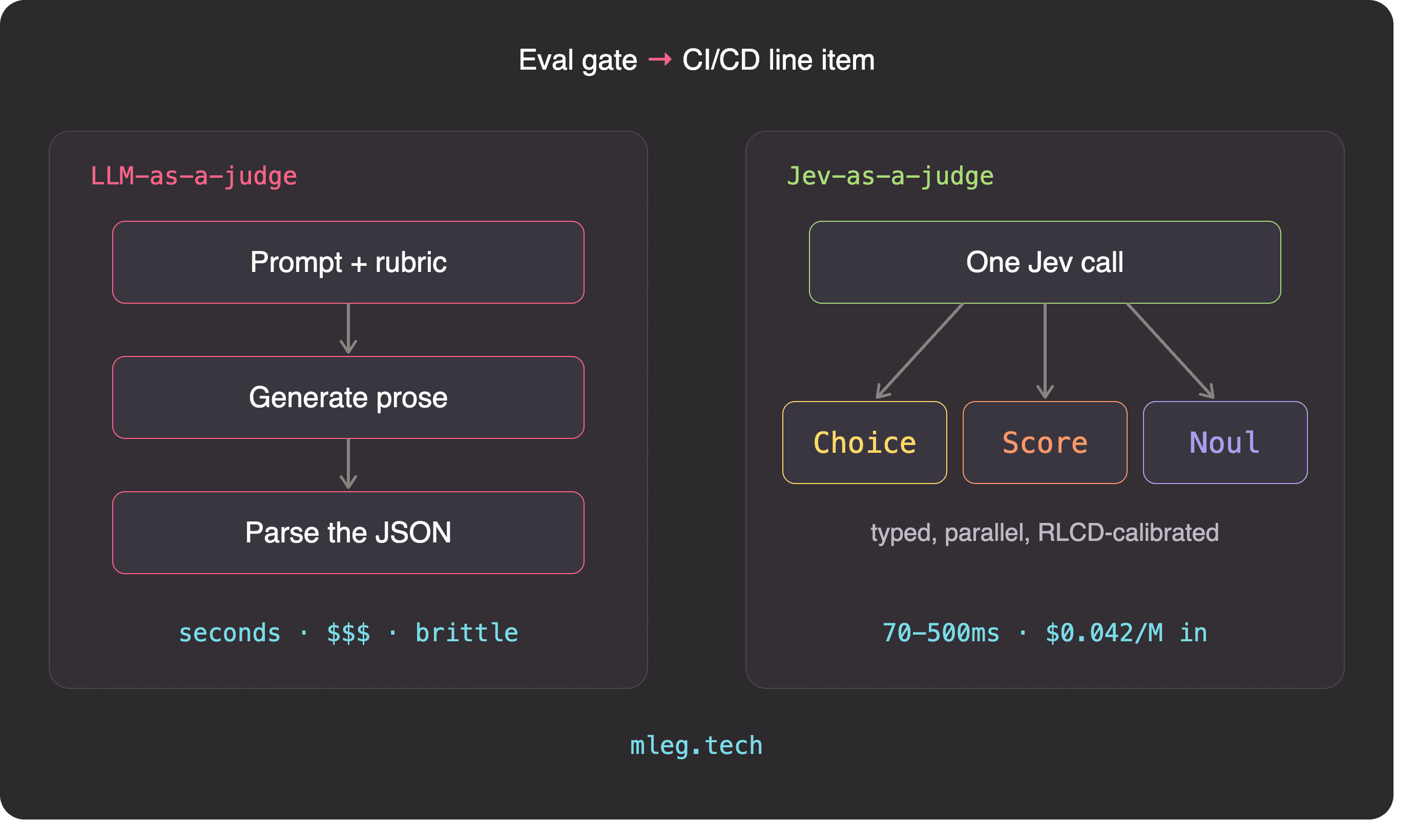
I'm running Jev, TypeSafe AI's textless "System-1" model, as the judge inside my eval harnesses. The question: can evals run on every commit instead of once a night?
Where this stands. I'm mid-experiment. Speed, cost and calibration figures below are Jev's claimed specs, not my measurements. I'll update this post as I collect my own results.
Why my evals ran nightly
LLM-as-a-judge is the default way to grade AI output, and it has been quietly shaping how I schedule evals. Three things push it out of the commit path:
- It's slow. A generative model writes a verdict token by token, so each judgment takes seconds.
- It's expensive at PR volume. Multiply per-judgment cost by every commit, every test case and every rubric, and sampling starts to look sensible.
- It's brittle. The verdict comes back as text, so I parse it. One malformed JSON blob can fail an entire run.
The result is a release gate. Regressions show up a day later, in a run that no longer maps to one commit.
What Jev is, as described
Jev is a textless, non-autoregressive "System-1" foundation model. It's built for fast, calibrated decisions rather than generated prose. For a judge, that means the model skips the "write a verdict, then parse it" step. One call returns typed primitives in parallel:
Choice: pick from a set of optionsScore: a numeric ratingNoul: a yes/no
Each comes with a probability calibrated using RLCD. Those probabilities are the part I care about most, because they give me something principled to put a threshold on.
The claimed specs:
- 20-200x faster than a traditional LLM judge
- 40-400x cheaper than a traditional LLM judge
- $0.042 per million input tokens, output tokens free
- 70-500ms latency per call
These are Jev's stated numbers. I'm verifying them in my own setups.
The hypothesis
If a judgment is cheap and returns in well under a second, an eval suite stops being a delayed release gate and becomes a line item in CI/CD. Every commit gets scored, and a regression is caught in the PR that caused it.
How I'm testing it
The setup is deliberately boring. Take a human-labeled golden set, judge it with my current LLM judge and with Jev, then compare the two on agreement, calibration, latency and cost.
Where the judge sits in CI
Jev only changes one layer of the pipeline. The commit, the agent under test, the dataset and the gate stay the same. That matters, because a judge swap I can revert in an afternoon is a lot easier to try than a new eval stack.
The harnesses I'm wiring it into
I'm not tied to one eval tool, so I'm trying the judge swap across the ones I use or want to compare: LangSmith, Langfuse, Braintrust, Amazon Bedrock AgentCore Evaluations, Strands Evals and DeepEval.
The pattern is the same everywhere: a thin custom scorer or evaluator calls Jev and maps the typed result back into the harness's own score format.
Harnesses tend to think in three kinds of results: categories, numbers and pass/fail. Jev's primitives line up with those, so the adapter is mostly a rename plus a threshold:
Every primitive carries a calibrated probability, so gates can threshold on p.
Back-of-envelope cost
The price is $0.042 per million input tokens with free output. The formula is judgments × tokens ÷ 1,000,000 × $0.042.
Pick a workload below to see what Jev-as-a-judge costs. The two implied rows show what the "40-400x cheaper" claim would mean for a traditional judge on the same workload. That is arithmetic on a claim, not a measurement.
Formula: judgments × tokens ÷ 1,000,000 × $0.042. Output tokens are free. The sliders are illustrative defaults, not real volume.
What I'm watching for
A fast, cheap judge is only useful if it's also right. These are the questions I'm trying to answer, and where things stand:
| Question | Status | What I found |
|---|---|---|
| Does Jev agree with my current LLM judge on labeled data? | Running | Pending |
| What latency do I see end to end in CI? | Running | Pending |
| Are the probabilities actually calibrated on my data? | Next | Pending |
| What does a full per-commit run cost me? | Next | Pending |
| Does per-commit evaluation change how I ship? | Next | Pending |
Where I'm skeptical
- No written rationale. A judge that doesn't generate prose likely can't explain itself in prose. I expect to keep a slower LLM judge for spot checks and for failures I need to debug.
- Calibration is a claim until it's checked. I'll test it on my own data instead of trusting it.
- Speed only helps if the harness keeps up. If my pipeline, not the judge, is the bottleneck, the win shrinks.
What's next
I'll fill in the results as they come in, and share the adapter pattern for each harness once I trust it. If you run evals in LangSmith, Langfuse, Braintrust, Bedrock AgentCore Evaluations, Strands Evals or DeepEval and want a particular case tested, send it over and I'll run it.
Jev is a model from TypeSafe AI. This is an independent experiment, not an official benchmark.